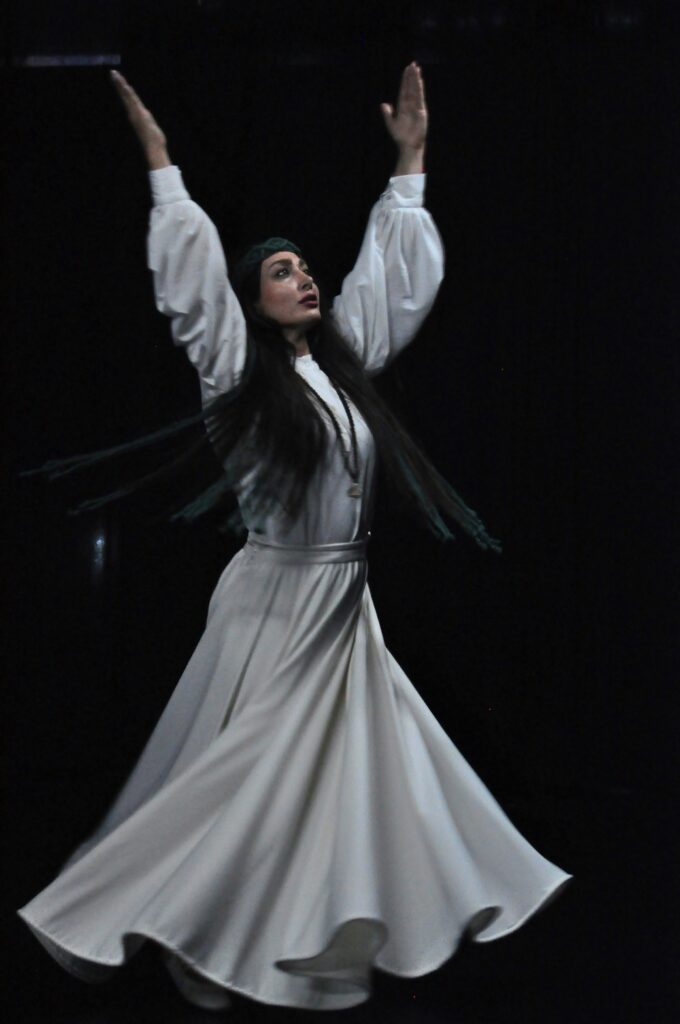
If you have ever watched a whirling dervish turn, robes opening like a flower, one hand raised to the sky and the other lowered to the earth, you may have felt something hard to name: a stillness inside movement. Sufi whirling is one of the most beautiful practices to come from the Islamic mystical tradition, and today people of every background are discovering it as a form of meditation. This guide explains where it comes from, what it feels like, and how a beginner can approach it with respect.
Where Sufi whirling comes from
Whirling is most closely associated with Jalal al-Din Rumi, the 13th-century poet and mystic who lived in Konya, in what is now Turkey. After his death in 1273, his followers formed the Mevlevi order, and the whirling ceremony they developed, called the sema, became its best-known ritual. In 2008, UNESCO inscribed the Mevlevi Sema Ceremony on its list of the Intangible Cultural Heritage of Humanity.
In the formal ceremony, every gesture carries meaning. The tall felt hat is often described as the tombstone of the ego and the white skirt as its shroud. As the dervish turns, the right palm faces upward to receive and the left palm faces downward to give, so that what comes from above passes through the heart and into the world. The turning itself echoes the movement of everything in the universe, from atoms to planets.
The ceremony and the practice are not the same thing
It is worth being clear about one distinction. The sema performed by trained Mevlevi dervishes is a sacred ritual with a long lineage, years of training and its own music, prayers and structure. What most retreats and workshops offer is something different and more modest: whirling as a personal moving meditation, inspired by that tradition.
Holding this distinction with humility matters. You are not imitating a ceremony; you are using one simple element of it, turning around your own centre, as a doorway into presence.
What whirling feels like
For most people, the first few turns feel awkward. The room spins, the feet are unsure, and the mind is busy worrying about falling. Then, often quite suddenly, something shifts. When you stop trying to look at the room and let your gaze soften, the spinning seems to move outside you while a quiet point remains inside. Many people describe it as the first time they have felt their own centre.
Afterwards, it is common to feel calm, emotional, light or simply very awake. Some people cry; others laugh. There is no right experience.
How a beginner can start
If you would like to try whirling, these are the basics most teachers share. Always learn with someone experienced the first time.
- Prepare your body. Turn on an empty or light stomach, and warm up your ankles, knees and neck.
- Find your anchor. Traditionally, you turn anticlockwise, pivoting on the left foot while the right foot pushes you gently around.
- Use your hands. Begin with arms crossed over your chest, then slowly open them: right palm up, left palm down.
- Soften your gaze. Do not fix your eyes on the room. Many people look at the raised hand or let the eyes rest unfocused.
- Start slowly and stop slowly. Speed is not the goal. When you finish, slow down gradually, cross your arms over your heart and lie down or sit quietly for a few minutes.
If you have problems with balance, inner-ear conditions, low blood pressure, are pregnant, or take medication that affects balance, speak to a doctor before trying, and tell your teacher.
Why whirling belongs on a retreat
Whirling works best when there is time around it: time to warm up with gentle yoga or breathwork, time to turn without rushing, and time afterwards to rest, write or sit in silence. That is why we weave it into a wider rhythm of practice on our journeys in Turkey, alongside meditation, Nâm Yoga, music and poetry.
On our 12-Day Soul Journey in the Footsteps of Rumi and the shorter Path of Love: Nâm Yoga, Active Meditation and Whirling, whirling is introduced gently, as a personal practice rather than a performance. Our longest journey, the 15-Day Path of Love in Konya and Cappadocia, also brings you to Konya, the city where Rumi lived and where he is buried.
Turning towards the heart
Rumi’s poetry returns again and again to one idea: that what we are searching for is already within us. Whirling makes that idea something you can feel in your body. You turn and turn, and the one thing that does not move is the centre. That centre, in the language of the Sufis, is the heart.
If you feel drawn to explore this practice in the land where it was born, take a look at our Sufi and yoga retreats in Turkey, or answer a few gentle questions in our Find Your Retreat questionnaire.
Frequently asked questions
Can anyone learn Sufi whirling?
Most people can learn the basics with an experienced teacher, starting slowly. If you have balance or inner-ear problems, low blood pressure, are pregnant or take medication that affects balance, check with a doctor first.
Which direction do whirling dervishes turn?
Traditionally anticlockwise, pivoting on the left foot while the right foot pushes gently around.
Will I get dizzy?
Many beginners feel dizzy at first. Turning slowly, softening your gaze and stopping gradually all help, and the dizziness usually lessens with practice.
Is whirling a religious practice?
The Mevlevi sema is a sacred Sufi ritual. Whirling as taught on retreats is a moving meditation inspired by that tradition, open to people of all backgrounds and approached with respect.